- Home
- Printable Trivia
- True Or False Trivia Questions
True or False Trivia Questions
70+ True or False Questions for an Epic Senior Showdown!
Today's mission, should you choose to accept it, involves diving headfirst into a pool of brain-bending true or false trivia questions that'll make your senior gatherings more fun and memorable. So, grab a seat, a pen, and maybe a thinking cap because it's time to start your super silly trivia adventure!

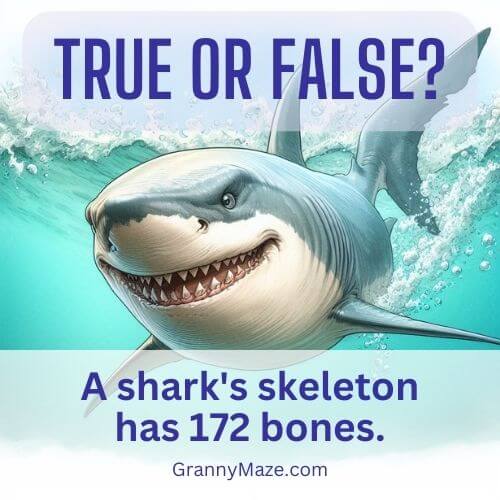
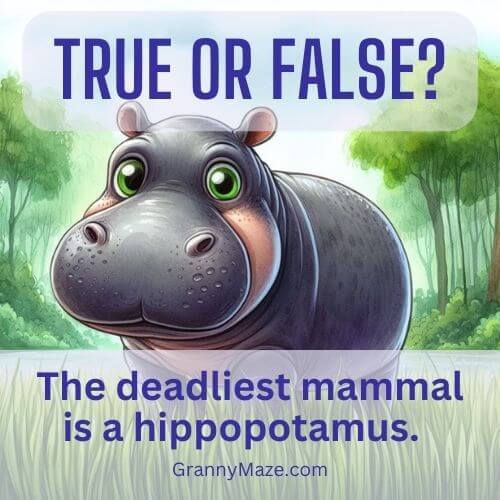
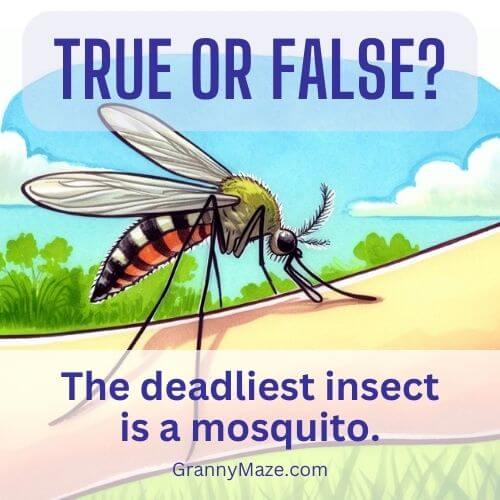
The Quest for Senior Brainpower
In the vast realm of brain games, True or False Trivia stands tall as the undisputed champion. But today's collection isn't your run-of-the-mill trivia. No, no, no. These questions are crafted to be interesting, fun, and just a tad tricky. So, let's get started!
Listed below are multiple themed sets of questions — from general knowledge to science, history, and everyday life — so you can play a quick round, plan a longer session, or come back later without repeating the same questions.
The Challenge: 70 True or False Trivia Questions
Each question is designed to spark a quick decision - true or false - with answers revealed further down the page.
1. True or False: Honey Never Spoils?
2. True or False: Bananas Are Berries?
3. True or False: Penguins Only Live in the Antarctic?
4. True or False: Lightning Never Strikes the Same Place Twice?
5. True or False: Your Taste Buds Change Every Seven Years?
6. True or False: Goldfish Have a 3-Second Memory?
7. True or False: The Great Wall of China is Visible from Space?
8. True or False: Lightning Bugs Are Not True Bugs?
9. True or False: Chameleons Change Color to Blend In?
10. True or False: The Eiffel Tower Can Grow Taller in the Summer?
11. True or False: Octopuses Have Three Hearts?
12. True or False: Carrots Improve Your Night Vision?
13. True or False: The Bermuda Triangle is More Dangerous than Other Parts of the Ocean?
14. True or False: The Mona Lisa Was Stolen from the Louvre in 1911 and Recovered Two Years Later?
15. True or False: Mars Has More Than One Moon?
16. True or False: Coffee Stunts Your Growth?
17. True or False: Is Memory Loss a Normal Part of Aging?
18. True or False: The Great Wall of China is the Longest Wall in the World?
19. True or False: Dogs Only See in Black and White?
20. True or False: Peanuts Are Nuts?
21. True or False: The Tomato is a Fruit?
22. True or False: Mount Everest is the Tallest Mountain?
23. True or False: Humans Only Use 10% of Their Brains?
24. True or False: Spicy Food Causes Ulcers?
25. True or False: Lightning Can Strike Sand and Create Glass?
Bonus True or False Trivia Question Answers
*According to the prevailing science, individuals of most species can't recognize their reflections as themselves. The only known exceptions are humans, some great apes, and possibly dolphins, elephants, and magpies - all animals with high intelligence.
True or False Trivia Answers
1. True. Honey's low moisture content and acidic pH make it a hostile environment for bacteria and microorganisms, ensuring its long shelf life.
2. True. Botanically speaking, bananas qualify as berries, characterized by their fleshy pericarp and seeds on the inside.
3. False. While some penguin species inhabit the Antarctic, others thrive in diverse climates, Antarctica to various remote islands and the southern coasts of Africa, Australia, New Zealand and South America.
4. False. Lightning can indeed strike the same location repeatedly, especially if it's a tall and isolated object. For example, the Empire State Building is hit about 25 times per year.
5. False. Taste buds get replaced every 2 weeks or so. But as we age, some of our taste bud cells don't get replaced.
6. False. Goldfish possess a more extended memory span than commonly believed, with studies showing they can remember information for months.
7. False. Contrary to popular belief, the Great Wall is not visible from the moon and is difficult to spot from Earth orbit without the aid of high-powered lenses.
8. True. Lightning bugs, or fireflies, belong to the order Coleoptera, which consists of beetles, not the order Hemiptera, the true bugs like Cicadas, Hoppers, or Aphids.
9. True. Chameleons change color for various reasons, including communication, temperature regulation, and blending into their surroundings for camouflage.
10. True. On the hottest summer days, the Eiffel Tower quietly stretches as the iron expands. Engineers who monitor the structure measure a seasonal height change of about 12–15 centimeters (5–6 inches). The expansion happens gradually due to heat and sits well within safe design limits thanks to the tower’s lattice structure, riveted joints, and uneven heating.
11. True. Octopuses have three hearts, two branchial hearts pumping blood to the gills to pick up oxygen and one systemic heart circulating blood to the rest of the body.
12. Half Truth! While carrots are rich in vitamin A, which helps the eye to convert light into a signal that is sent to the brain, helping us to see in the dark. It will only make a big difference for someone who suffers from a vitamin A deficiency. So, consuming excess won't grant you superhuman night vision.
13. False. The Bermuda Triangle's reputation for mysterious disappearances is not statistically higher than other areas of the ocean.
14. True. The iconic painting by Leonardo da Vinci, the Mona Lisa, was stolen in 1911 and recovered in 1913, creating a sensational art heist in history.
15. True. Mars has two moons - their names are Phobos and Deimos.
16. False. The notion that coffee hinders growth is a myth; there's no scientific evidence supporting this claim.
17. True. As one ages there is modest memory loss, primarily short-‐term memory (recent events).
18. False. While the Great Wall is extensive, it's not the longest wall globally; the Great Wall of Benin holds that title.
19. False. Dogs see a limited spectrum of colors, but they are not entirely colorblind and can perceive certain hues.
20. False. Despite the name, peanuts are legumes, not true nuts, as they grow underground.
21. True. Botanically, tomatoes are classified as fruits, as they develop from the ovary of a flower and contain seeds.
22. False. While Mount Everest is the highest peak above sea level, Hawaii's Mauna Kea, measured from its base on the ocean floor, is taller. Four thousand feet taller!
23. False. This widely circulated myth has been debunked; humans use a significant portion of their brains. Studies have shown that far more than 10% (35%) of the brain is active at any given time.
24. False. Spicy food doesn't cause ulcers; in fact, certain spices may have anti-inflammatory properties.
25. True (sort of). When lightning strikes sand, the intense heat can fuse the grains, forming natural glass structures known as fulgurites, tube-like glass formations beneath the ground. Nature's artistic touch indeed!
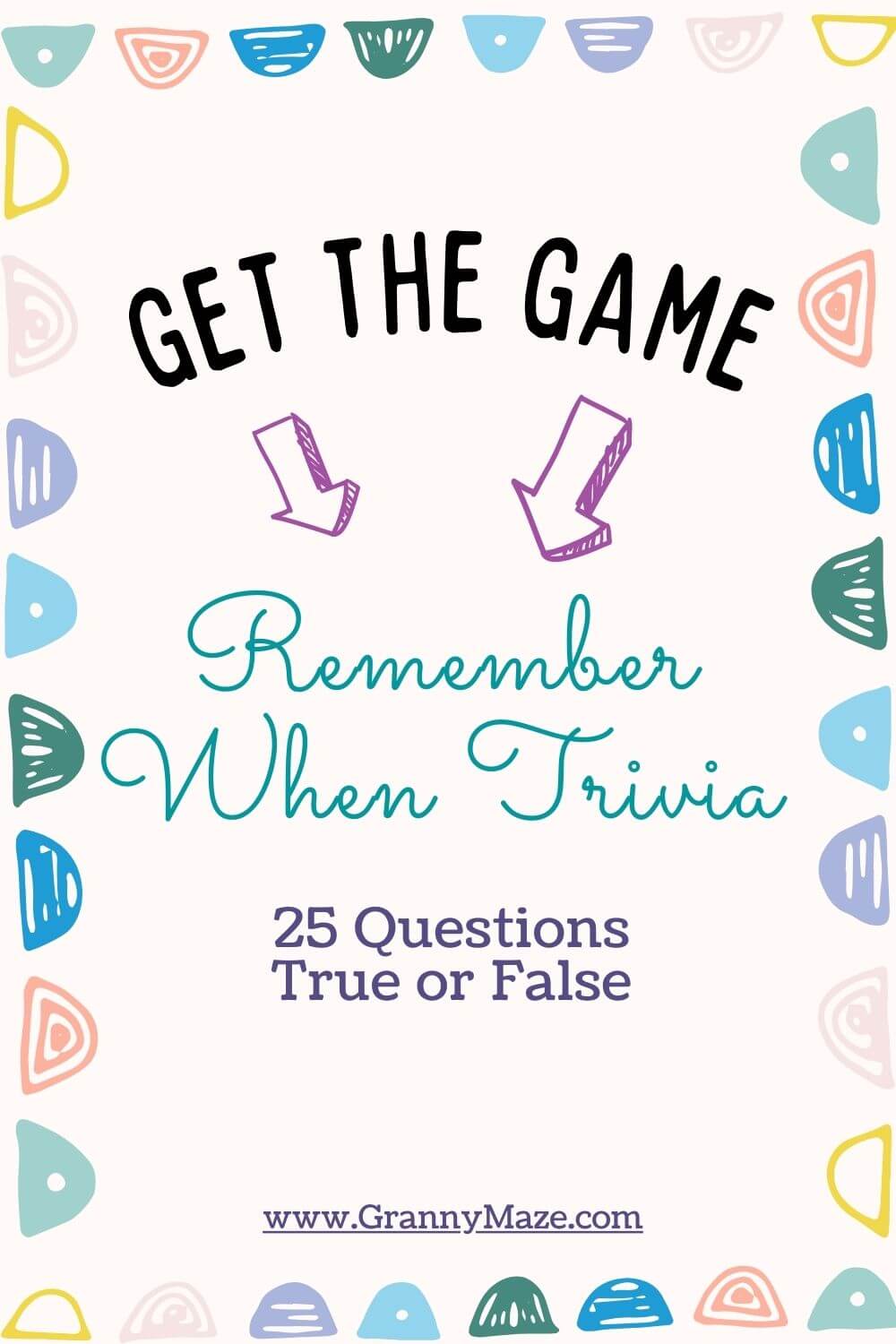
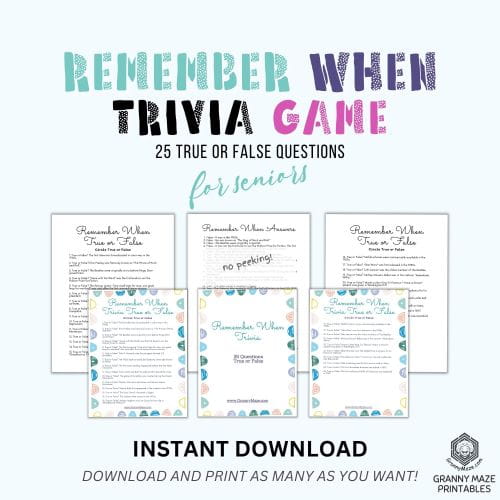
Get the Remember When True or False Trivia Game
This printable game includes themed questions designed to spark memories, discussion, and laughter.
Scoring Your True or False Trivia Questions
Wondering how you fared in this True or False Trivia quiz? Here’s one way you can interpret your score:
19 - 22 correct: Bravo, Trivia Virtuoso! You’ve got a sharp memory and a curious mind. Nicely done.
10 - 18 correct: Solid showing. A few surprises probably caught you off guard — that’s part of the fun.
0 - 9 correct: No stress at all. Every round is practice, and guessing keeps things light. Every question is a step towards boosting your mental agility. Keep learning, keep smiling, and let the games continue!
Sample Questions from The Game
Just click on the little arrow for your answer.
Q1: True or False? Coca Cola was the first soda drink to be sold in cans.
Q1: True or False? Coca Cola was the first soda drink to be sold in cans.
False – Coco Cola was introduced in 1955, Cliquot Club Ginger ale was the first soda sold in a can in 1938.
Q2: True or False? John Lennon was the oldest member of The Beatles.
Q2: True or False? John Lennon was the oldest member of The Beatles.
False - Ringo Starr was the oldest member.
Q3: True or False? The game of Scrabble was created during the Great Depression.
Q3: True or False? The game of Scrabble was created during the Great Depression.
True
25 True or False Trivia Questions Printable Game
25 QUESTIONS & ANSWERS | 7 PAGES | MODERATE
$5.95
How to Use These True or False Trivia Questions with Seniors
After this section, you’ll find more true or false trivia question sets you can keep playing straight from the page.
These true or false trivia questions are flexible by design. You can run a quick round, stretch them into a longer session, or mix sections together depending on your group and the time you have.
Group size:
- Works well for 1–12 players
- Larger groups can play in teams, which keeps things relaxed and social
How long to play:
- 10–15 questions for a short round
- 25 questions work well for a full session
- Mixing sections keeps repeat sessions from feeling predictable
How to run the game:
- Read questions aloud so everyone can hear clearly
- Allow a brief pause before answering
- Encourage discussion — the debates are often the best part
Scoring options:
- Play individually with simple score sheets
- Use team scoring for group settings
- Or skip scoring and play purely for conversation (there’s no penalty for being wrong)
For Different Abilities and Comfort Levels
These true or false trivia questions are easy to adapt so everyone can take part comfortably.
- For vision challenges: large-print sheets help, but reading questions aloud keeps everyone included, even those who prefer not to read along.
- For hearing challenges: speak slowly, face the group when reading questions, and repeat answers clearly. Visual prompts can help too — for example, drawing a quick sketch for questions about clouds, animals, or objects.
- To reduce pressure: team play works well. Let players discuss answers together so no one feels put on the spot.
- For limited mobility: printable games are ideal because everything can be played from a seat. If movement is welcome, place questions in a bowl or hat and invite volunteers to draw a question or read it aloud.
- To build confidence and connection: let different players take turns reading questions or revealing answers. Small leadership moments often boost engagement and camaraderie.
These adjustments keep the focus on participation, conversation, and enjoyment rather than speed or score.
Creative Ways to Run a True or False Trivia Session
- Run a themed round. Choose one section only — science, nostalgia, or everyday life — and let the theme guide the session. Light dress-up (hats, colors, decade touches) adds fun without pressure.
- Use discussion rounds. After answers are chosen, invite one or two people to explain their choice before revealing the answer. These moments often spark the best stories.
- Try team play with intention. Pair players with different strengths — memory, logic, storytelling — and let them decide together. It keeps the game social and relaxed.
- Let the group choose prizes. Ask players ahead of time to suggest fun prizes. Bragging rights, homemade certificates, or silly hats work better than anything fancy.
- End with a reflection question. Ask which question surprised them most or sparked the most debate. It’s a natural way to wrap up without rushing.
This format works just as well for quiet one-on-one play as it does for group activities, family gatherings, or regular game nights.
If you’re planning multiple sessions, you may also want to look at:
Fun and Silly Facts: True or False Trivia Questions
This round leans into the kinds of facts that sound obvious… until you stop and think. Some answers are surprising, some spark debate, and a few might earn a raised eyebrow or two before the truth comes out.
Fun and Silly Facts: Questions
26. True or False: An ostrich’s brain is bigger than its eye.
27. True or False: You can't hum while holding your nose closed.
28. True or False: Wombat poop is cube shaped.
29. True or False: The human brain produces enough electricity to power a small light bulb.
30. True or False: Humans have more genes than a banana.
31. True or False: There are more possible games of chess than atoms in the observable universe.
32. True or False: A sneeze travels faster than a car on the highway.
33. True or False: Octopuses taste with their suckers.
34. True or False: The average cloud weighs more than a million tons.
35. True or False: Butterflies do not remember being caterpillars.
36. True or False: Some turtles can breathe through their rear ends.
37. True or False: Humans glow faintly in the dark.
38. True or False: A duck’s quack does not echo.
39. True or False: You share your birthday with at least 9 million other people worldwide.
40. True or False: The brain can’t tell the difference between real laughter and fake laughter.
Fun and Silly Facts: Answers
26. False. An ostrich’s eye is larger than its brain, which helps with wide-range vision — even if it sounds backward.
27. True. Try it. Humming requires air passing through the nose, which you block when you pinch it closed.
28. True. Wombat droppings are famously cube-shaped, which helps keep them from rolling away.
29. True. The electrical activity generated by neurons in the brain produces enough power to light a small LED bulb under the right conditions.
30. False. Humans have around 20,000 protein-coding genes, while bananas have over 36,000.
31. True. The number of possible chess games (the Shannon number) is astronomically larger than the number of atoms we can observe.
32. True. A sneeze can travel at speeds of 30 to 100 miles per hour (about 48–160 kilometers per hour), which is faster than many cars on a highway. It’s one of the quickest reflexes the body has for clearing irritants.
33. True. Octopus suckers contain taste receptors, allowing them to “sample” what they touch.
34. True. Even a fluffy-looking cumulus cloud can weigh over a million tons due to the sheer volume of tiny water droplets it contains.
35. False. Studies show butterflies do retain memories formed as caterpillars, even after metamorphosis. Butterflies don’t consciously remember being caterpillars in a human, story-like way. However, they can retain learned associations — such as avoiding certain smells — formed during the caterpillar stage. This happens because some brain structures involved in learning survive metamorphosis.
36. True. Certain turtles can absorb oxygen through their cloaca, allowing them to breathe underwater.
37. True. Humans emit a faint visible light due to biochemical reactions, but it’s far too weak for our eyes to detect.
38. False. A duck’s quack does echo — it’s just hard to hear under most conditions.
39. True. With over 8 billion people on Earth, millions share the same birthday as you.
40. True. The brain responds similarly to genuine and forced laughter, which is why laughing on purpose can still lift mood.
Prefer these true or false trivia questions in a printable format? Take a look at the Remember When True or False Trivia Game.
History and Nostalgia: True or False Trivia Questions
This set focuses on well-known events, inventions, and moments many people lived through or clearly remember but with details that are often misremembered.
History and Nostalgia: Questions
41. True or False: The telephone was invented before the automobile.
42. True or False: The Berlin Wall fell on November 9, 1991.
43. True or False: The microwave oven was invented by accident.
44. True or False: The Union Jack appears on the Hawaiian flag because Hawaii was once ruled by Britain.
45. True or False: The Beatles broke up before the moon landing.
46. True or False: Color photographs existed before color television.
47. True or False: The first credit cards appeared before World War II.
48. True or False: The United States banned alcohol nationwide for over a decade.
49. True or False: The first personal computers were smaller than modern laptops.
50. True or False: Television remote controls became common before color TV.
51. True or False: A 45 record typically played for about 35 minutes.
52. True or False: The first commercial jet airliner entered service in the 1950s.
53. True or False: The first Super Bowl was broadcast in black and white.
54. True or False: The Statue of Liberty was originally intended for Egypt.
55. True or False: Rock and roll music was controversial when it first became popular.
History and Nostalgia: Answers
41. True. The telephone was patented in 1876, while practical automobiles appeared years later.
42. False. The Berlin Wall fell on November 9, 1989, not 1991.
43. True. The microwave oven was discovered accidentally during radar research in the 1940s.
44. False. Hawaii was never ruled by Britain. The Union Jack was added as a diplomatic symbol of friendship while Hawaii remained independent.
45. False. The Beatles officially broke up in 1970, after the 1969 moon landing.
46. True. Color photography (1861) existed decades before color television broadcasts became common.
47. True. Early forms of credit cards were introduced in the 1920s and 1930s.
48. True. Prohibition lasted from 1920 to 1933 in the United States.
49. False. Early personal computers were large, bulky, and far bigger than modern laptops.
50. True. Remote controls became widely used in the 1950s, before color TV was standard.
51. False. A 45 record typically played only a few minutes per side. Long-playing albums were designed to hold much more music.
52. True. Commercial jet airliners entered passenger service in the 1950s (1952).
53. False. Super Bowl I (Jan 15, 1967) was available in color on CBS (it was marketed as a full-color broadcast), and it was simulcast with NBC.
54. True. Early designs for the Statue of Liberty were proposed for Egypt before being adapted for the U.S.
55. True. Rock and roll was widely criticized when it first emerged, especially for its influence on youth culture.
This collection of true or false trivia questions with answers is designed for easy play straight from the page, but if you’d rather have a complete round in a ready-to-print format you can use anytime, the Remember When True or False Trivia Game is available here.
Everyday Life: True or False Trivia Questions
This round looks at everyday things many people grew up with — food, games, technology, and daily habits that were once normal and now feel almost unbelievable.
Everyday Life: Questions
56. True or False: A&W Root Beer was originally sold as a health drink.
57. True or False: Television commercials were originally shown live.
58. True or False: Many people in their 80s and 90s walk at least 10,000 steps a day.
59. True or False: Dodgeball was once banned in some schools for being too dangerous.
60. True or False: Crystallized intelligence continues to improve well into your 60s and 70s.
61. True or False: Seniors contact friends and family more through text messaging than phone calls.
62. True or False: Most seniors today use a smartphone daily.
63. True or False: Credit cards were uncommon for everyday shopping before the 1960s.
64. True or False: Grocery stores once allowed customers to buy items “on account.”
65. True or False: Home milk delivery was common in many neighborhoods.
66. True or False: Folks over 65 regularly get a good night’s sleep.
67. True or False: Many seniors still go to rock concerts.
68. True or False: Telephones were once shared between multiple households on the same line.
69. True or False: In a study of women over 40, those over 80 reported higher sexual satisfaction than some younger age groups.
70. True or False: 95% of seniors have a pet.
Everyday Life: Answers
56. True. A&W Root Beer was originally marketed as a health drink made from herbs and roots.
57. True. Early television commercials were often performed and broadcast live.
58. False. While many older adults stay active, most people in their 80s and 90s do not walk 10,000 steps a day.
59. True. Dodgeball has been banned or restricted in some schools due to safety concerns.
60. True. Crystallized intelligence — knowledge and life experience — can continue to improve into later adulthood.
61. False. Although texting is common, many seniors still rely more on phone calls to stay in touch.
62. True. Smartphone use among seniors has increased significantly, with many using one daily.
63. True. Credit cards existed earlier but were not commonly used for everyday purchases until the 1960s.
64. True. Buying groceries “on account” was once a common practice.
65. True. Home milk delivery was widespread in many neighborhoods.
66. False. Sleep often becomes lighter and more interrupted after age 65.
67. True. Many seniors continue to attend live music events, including rock concerts.
68. True. Party lines allowed multiple households to share a single telephone line.
69. True. Studies summarized by WebMD report high levels of sexual satisfaction among women over 80 compared with some younger groups.
70. False. About 95% of seniors do not have a pet; while pets offer benefits, only a smaller percentage of older adults are pet owners.
If you’d prefer a ready-to-use printable version, the Remember When True or False Trivia Game lets you download and play anytime.
HOME | PRIVACY POLICY | TERMs of use | REFUND POLICY | CONTACT | SITEMAP
Copyright © 2023- | GRANNYMAZE.COM | ALL RIGHTS RESERVED regardless of links or attributions